Dotted rhythm practice: how to even out uneven passagework
Dotted rhythm practice pairs up the notes of a fast passage and plays them long–short in a dotted rhythm, then short–long in a reverse-dotted rhythm, before returning to the written rhythm. Each long note gives your hand a moment to release tension and prepare the next finger transfer, so when you return to the score the passage comes out cleaner and more even.
At a glance
- Use it when a fast passage of equal note values, such as sixteenth-note scales or broken chords, sounds uneven.
- Play it long–short twice and short–long twice, then return immediately to the written rhythm.
- You don’t need a strict 3:1 ratio. Relax on the long note and snap cleanly from the short note into the next long note.
When to use it
Use it when a scale or passage that feels even at a slow tempo starts to bunch up, rush, or leave gaps as you bring it up to tempo. That unevenness usually happens where a finger transfer, often between fingers 3, 4, and 5 or across a thumb crossing, isn’t ready in time.
- Anywhere four or more equal notes follow one another: scales, arpeggios, broken chords, and technical studies such as Hanon or Czerny.
- When one hand is noticeably less even than the other: isolate that hand first.
- Triplet passages don’t divide into pairs. Use shifting accents in groups of three instead.
How the score changes
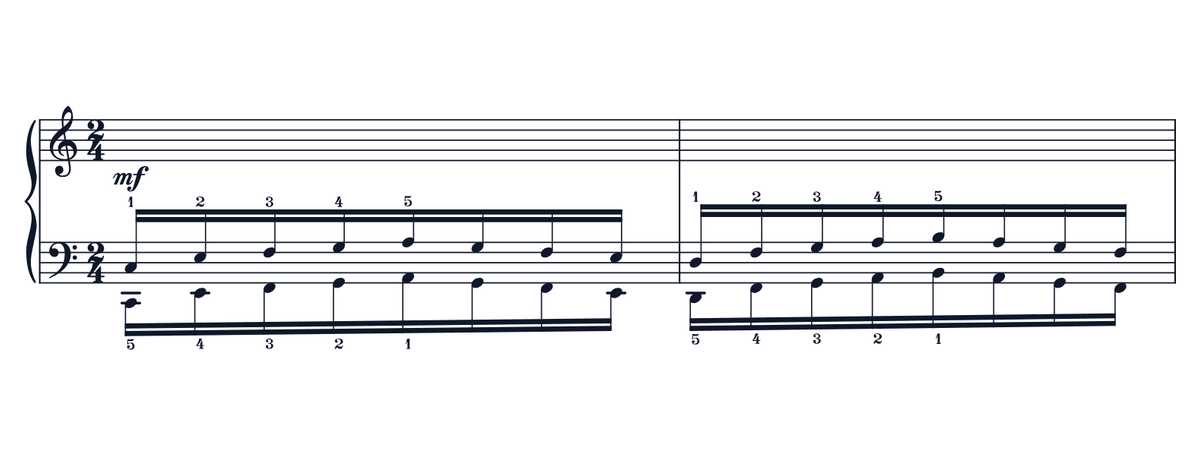
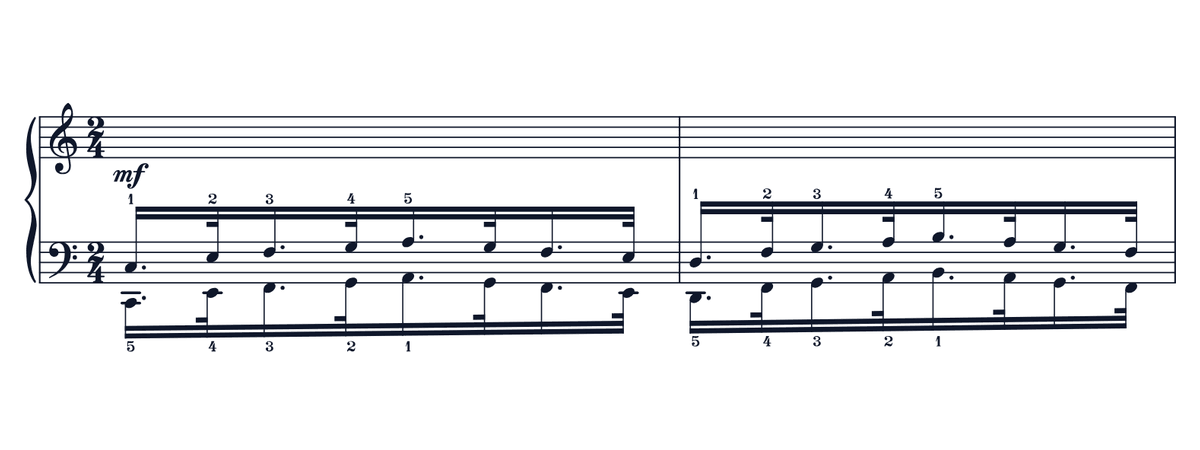
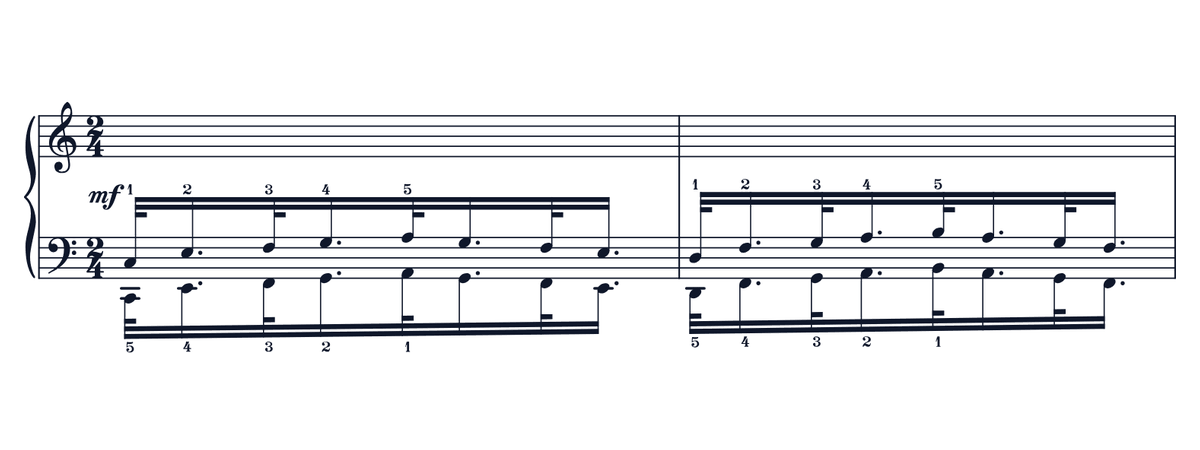
Group the notes into pairs along the beat. Dot the first note and halve the second for a long–short dotted rhythm, then reverse the pair for a short–long reverse-dotted rhythm. Pitches and fingering stay identical, and each pair still takes the same total time within the beat.
- As written
- Long–short
- Short–long
Practice order
- Once as writtenListen for which finger transitions bunch up. Choose the tempo right where the passage starts to lose its evenness.
- Long–short, twiceRest lightly on each long note while placing the next finger over its key, then move briskly through the short note into the next long note.
- Short–long, twiceNow pause on the second note of each pair. Pairing both patterns ensures every single finger transition is practiced both slowly as preparation and quickly in motion.
- Return to the written scorePlay the passage as written at the same tempo and listen for cleaner, more uniform spacing between notes.
In Virtu, the score changes for you
From the Technique stage on, after you play, Virtu points out the bars where one hand’s passagework came out uneven. Choose Practice in dotted rhythms in the result, and it rewrites those bars in dotted rhythms on the score and plays them to you once.
- It checks that each long note is clearly longer than its paired short note rather than enforcing a rigid 3:1 ratio.
- After long–short twice and short–long twice, it returns you to the written score to verify the improvement.
- When the set finishes, it shows whether the passage became more even compared with plain repetition.
Dotted rhythms and the other six practice drills come with Virtu Plus.
Dotted rhythms 1/4 doneNext: long–short · 2/4
Common mistakes
Counting a rigid ratio instead of preparing the next finger
Trying to measure an exact 3:1 ratio makes the motion stiff. Treat the long note as a calm preparation point and the short note as a quick, light step onto the next key.
Practicing only long–short
If you only play long–short, your hand learns to pause on every odd-numbered note, which leaves a two-note grouping habit when you return to the score. Always follow long–short with short–long so every transition is trained equally.
Skipping the return to the written rhythm
Dotted rhythms are a means to an end. Always finish the cycle by playing the passage straight so your fingers carry that clarity back into the real rhythm.
Stop if your wrist or forearm tightens. Never press into the key bed during the long note. Release excess finger pressure as soon as the note sounds and let your hand rest lightly on the key while preparing the next motion.
Other drills for the same passage
- Dotted rhythmsPlay it long–short and short–long to even out the notes
- Shifting accentsMove a strong note along so every finger rings clearly
- Short burstsPlay a few notes fast, then stop, beat by beat
- Alternating temposAlternate slow with the speed you're practicing at
- Playing staccatoPlay every note short to keep your fingers light
- Changing dynamicsGrow louder, then softer, to even out each finger's weight
- Play as chordsPress each broken chord at once to learn the hand shape first
Questions
How fast should I practice dotted rhythms?
Start at the tempo where the written passage first begins to sound uneven. If the quick pair in the dotted pattern feels rushed or sloppy there, lower the tempo slightly until every short–long snap is clean.
Should I practice dotted rhythms hands separately or hands together?
Isolate the uneven hand first. When both hands play identical rhythmic values in parallel motion, as in Hanon or parallel scales, you can also practice them hands together.
Does dotted rhythm practice work on triplets?
Because triplets group in threes rather than pairs, two-note dotted rhythms fight the beat grouping. Use shifting accents across every three notes instead.