Shifting accents: how to make every note of a fast passage ring clearly
Shifting accents groups the notes of a fast passage in fours or threes, places a clear accent on one note of each group, and rotates that accent to the next note in the group on each pass. Once every finger has taken a turn playing the accented note and you return to the score as written, notes that used to disappear under the fourth and fifth fingers speak with even tone and clarity.
At a glance
- Use it when fast sixteenth-note or triplet passagework sounds uneven because weak fingers drop out or the thumb sticks out.
- In groups of four, play four passes; in groups of three, play three passes, shifting the accent one note later each time.
- Ideal for triplet and sextuplet passages where two-note dotted rhythms don’t fit the beat.
When to use it
Use it when notes played by the fourth and fifth fingers get swallowed in a fast run, or when the heavier thumb accents unintentionally. Because the five fingers differ naturally in mass and leverage, deliberately rotating an accent across every position in a group trains each finger to play with equal clarity and teaches the surrounding fingers to stay light right after an accent.
- Anywhere four or more equal notes run together: scales, arpeggios, broken chords, and studies such as Hanon or Czerny.
- Triplet and sextuplet passages: because three-note groupings don’t divide into pairs for dotted rhythms, shifting accents in threes is the natural choice.
- When one hand sounds noticeably less even in tone: isolate that hand first.
How the score changes
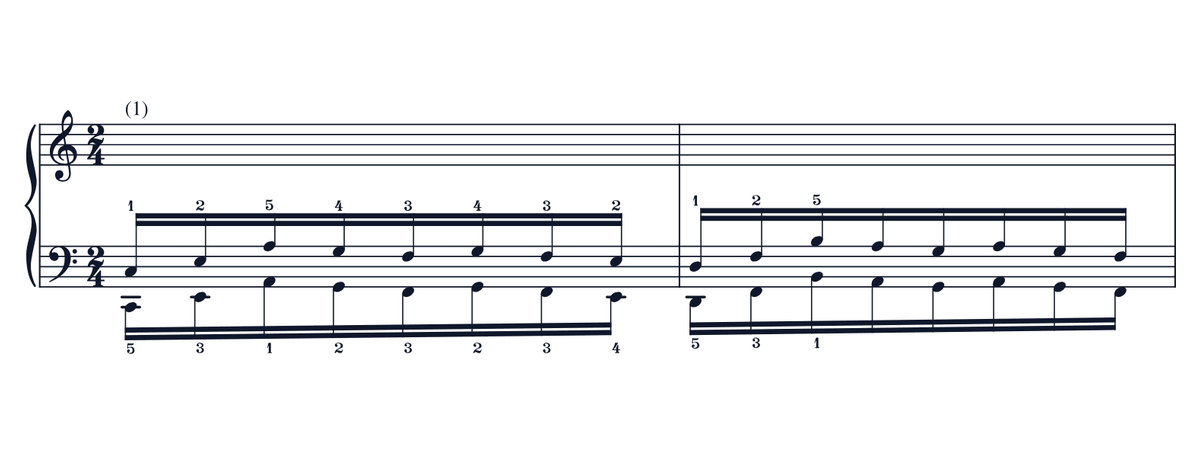
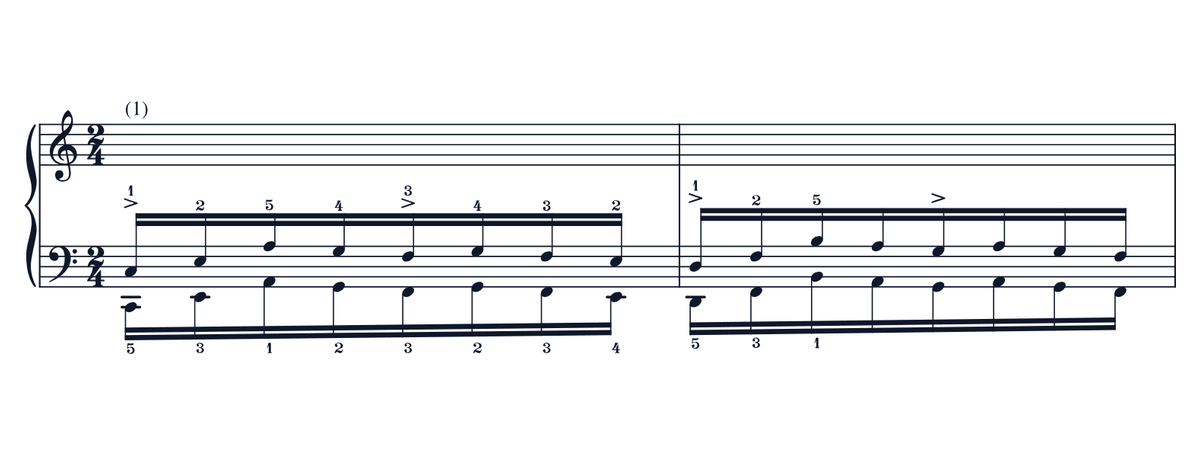
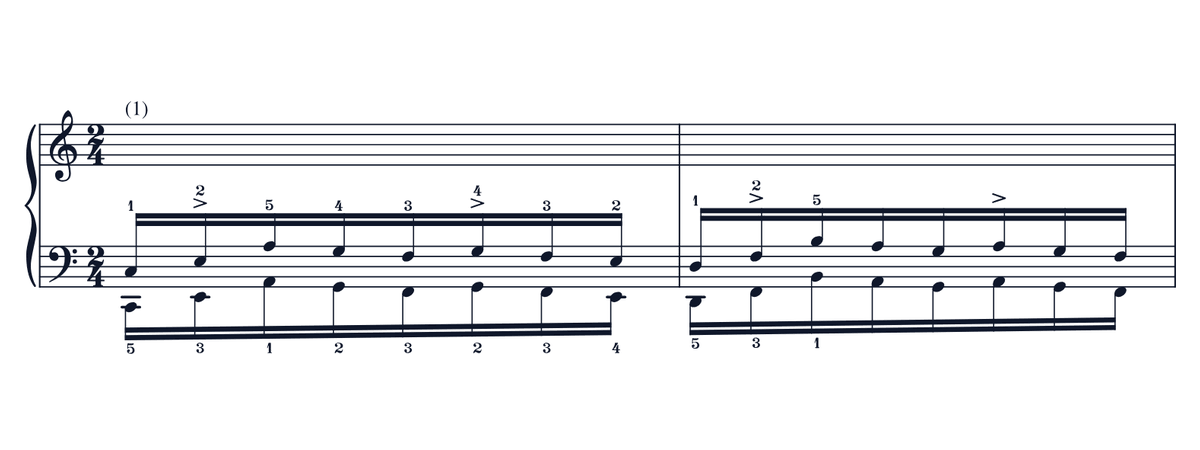
Group the passage along the beat starting from its first note. Sixteenth notes, thirty-second notes, and eighth notes paired across two beats go in fours; triplets and sextuplets go in threes. Place an accent mark on the first note of every group on pass 1, the second note on pass 2, and so on until every position in the group has been accented. Pitches, rhythm, and fingering stay unchanged.
- As written
- Accent on the first note
- Accent on the second note
Practice order
- Once as writtenListen for which notes drop out or thump. Choose the tempo right where tone and timing start to sound uneven.
- Accent the first note of each groupDrop a touch more arm weight into the accented note and release immediately so the remaining notes stay light and quiet.
- Rotate the accent one note at a timeRepeat the passage with the accent on the second note, then the third, then the fourth. Pay special attention to the passes where fingers 4 and 5 carry the accent.
- Return to the written scorePlay the passage without accents at the same tempo and listen for a balanced, pearl-like line.
In Virtu, the accents go on the score
From the Technique stage on, after you play, Virtu points out the bars where one hand’s run came out uneven. Choose Practice with shifting accents in the result, and it groups those bars’ notes, marks the accents on the score, and plays them to you once with the accented notes louder.
- It checks that the accented note was the loudest in its group, without demanding excessive force.
- When that holds across most groups, the accent advances to the next note; otherwise you repeat the same accent position.
- When the cycle finishes, you return to the score and see how your evenness compares with plain repetition.
Shifting accents and the other six practice drills come with Virtu Plus.
Shifting accents 1/4 doneNext: accent on note 2 · 2/4
Common mistakes
Pounding the accent and locking the wrist
An accent comes from a quick, focused key drop followed by an immediate release, not from stiffening your forearm. Play the unaccented notes piano so the accented note stands out effortlessly.
Hesitating right before the accented note
Pausing to wind up before an accent distorts the rhythm into a dotted pattern. Keep the pulse strictly even and vary only the dynamic weight.
Slurring over the unaccented notes
If the quiet notes between accents are blurry or rushed, the passage still won’t sound even. Keep every unaccented fingertip crisp and light.
Stop if your hand or forearm feels tense. Keep your wrist supple on every accent and release downward pressure the instant the note speaks.
Other drills for the same passage
- Shifting accentsMove a strong note along so every finger rings clearly
- Dotted rhythmsPlay it long–short and short–long to even out the notes
- Short burstsPlay a few notes fast, then stop, beat by beat
- Alternating temposAlternate slow with the speed you're practicing at
- Playing staccatoPlay every note short to keep your fingers light
- Changing dynamicsGrow louder, then softer, to even out each finger's weight
- Play as chordsPress each broken chord at once to learn the hand shape first
Questions
How loud should the accented note be?
Just clearly louder than its neighbors: think <em>mf</em> against <em>p</em> rather than hammering <em>ff</em>. Keeping the unaccented notes genuinely quiet creates contrast without strain.
How do I know whether to group in fours or threes?
Follow the subdivision of the beat. Sixteenth and thirty-second notes divide in twos and group in fours, while triplets and sextuplets divide in threes and group in threes so the accent cycle stays aligned with the beat.
How does shifting accents differ from dotted rhythm practice?
Dotted rhythms alter note durations to train fast finger preparation, while shifting accents keep the rhythm strict and vary touch weight to equalize finger strength and tone control. Shifting accents also work directly on triplet passages.