Fermata meaning in piano music: how long to hold it and how to go on
A fermata is the curved arc over a dot placed above or below a note or rest. It tells you to sustain that note or rest longer than its written duration. The exact length is up to your musical judgment, with roughly twice the written value serving as a common starting point. After the hold, take a brief breath and continue in the original tempo. Over a rest, a fermata pauses both sound and pulse in silence; over a barline, it asks for a brief breathing pause between phrases.
At a glance
- At a note or rest marked with a fermata, pause the regular pulse and let the moment settle.
- The duration is yours to shape: roughly double the written length is a classic starting point, guided by listening to the decay.
- Resume the original tempo after the fermata unless a new tempo marking appears.
- Virtu pauses the metronome and waits for you at every fermata, resuming the beat count the moment you strike the next note.
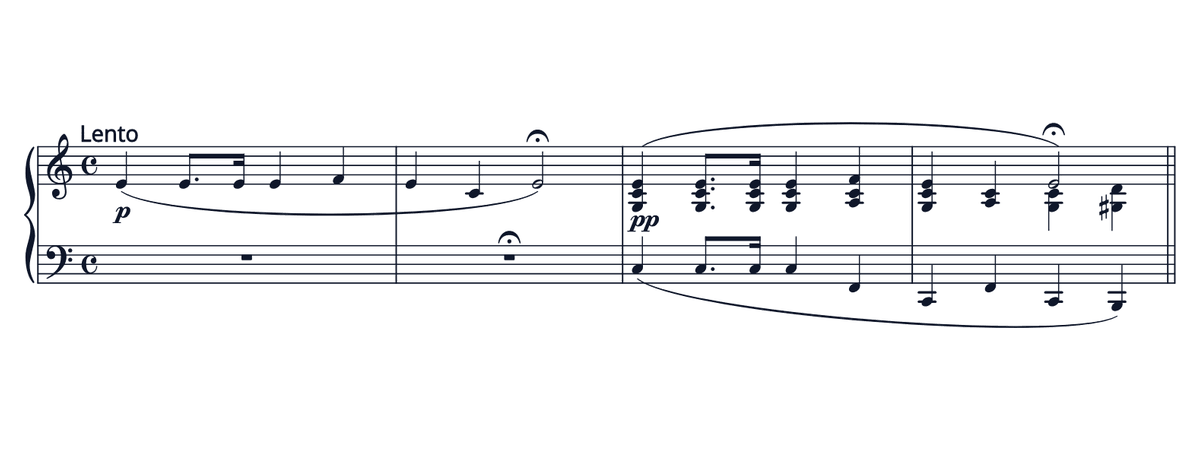
- Bars 1–4
What a fermata asks of you
How long should you hold it?
There’s no fixed beat count. Standard performance practice treats roughly twice the written value as a rule of thumb, but on the piano it’s far better to listen than to count: stay on the note or chord until its resonance has blossomed and your ear feels ready for what comes next. In the Chopin opening above, the fermata in bar 2 lets the quiet introductory question hang in the air, while the fermata in bar 4 gathers suspense right before the stormy Allegro erupts.
How to continue after the hold
A fermata stretches a single point in time; it doesn’t change the overall tempo of the piece. After releasing the hold, take a natural breath and enter the next phrase at the original tempo. In the Chopin example, bar 3 resumes the opening Lento pace after the bar 2 fermata, whereas the fermata at the end of bar 4 leads directly into the new Allegro con brio tempo.
When lower voices keep moving underneath
Look closely at bar 4 above: only the top note of the right hand carries a fermata, while the inner voices and left hand change harmony on beat 4. When one voice holds a fermata over moving parts, play the moving beats in normal time and begin the extra hold on the final beat where all voices sound together. Virtu’s reference playback follows the exact same rule, extending the hold from the last voice change before the fermata note ends.
Fermatas over rests
When a fermata sits over a rest, as in the left hand of bar 2, both sound and meter pause together. Keep your hands poised quietly over the keyboard, let the silence speak, and then enter the next bar together.
Fermatas over barlines
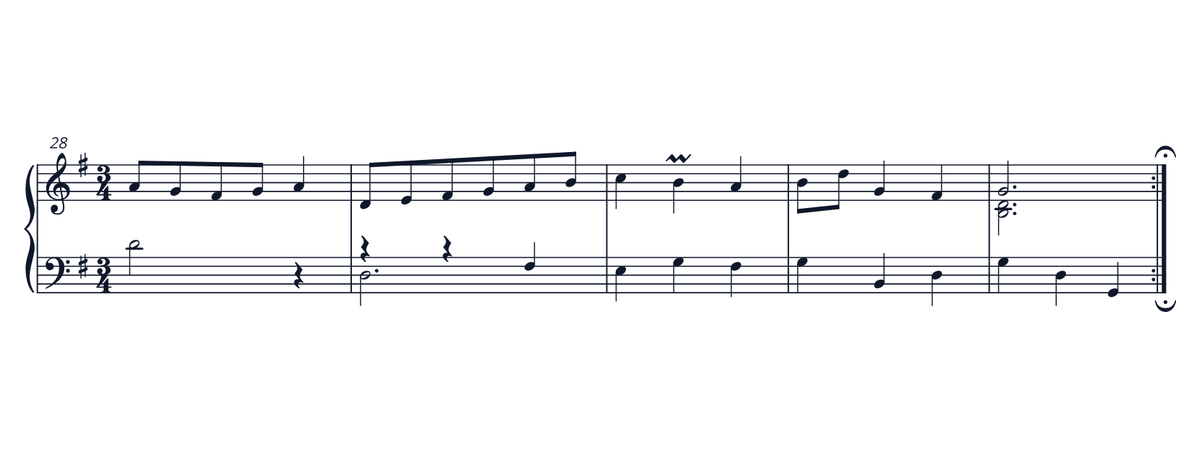
Placed directly over a barline or double bar, a fermata indicates a brief breathing pause between phrases before continuing. In Baroque notation, composers such as J. S. Bach also placed a fermata over the final barline of a section to mark the concluding point of a piece, where modern editions print Fine, as in Petzold’s Minuet below.
The end of Petzold’s Minuet: a fermata over the repeat barline
Petzold’s Minuet in G major, BWV Anh. 114, places fermatas above and below the repeat sign at the end of bar 32. Because they sit on the barline rather than on the final notehead, they mark the final conclusion of the dance.
- On the first pass before repeating: don’t hold. Keep the poised three-beat minuet pulse, take a quick breath, and return to bar 17.
- On the final pass after the repeat: this is the end of the piece. Let the final G-major chord ring out warmly before lifting your hands.
- Bars 28–32
The close of the “Moonlight” first movement: final chord and attacca
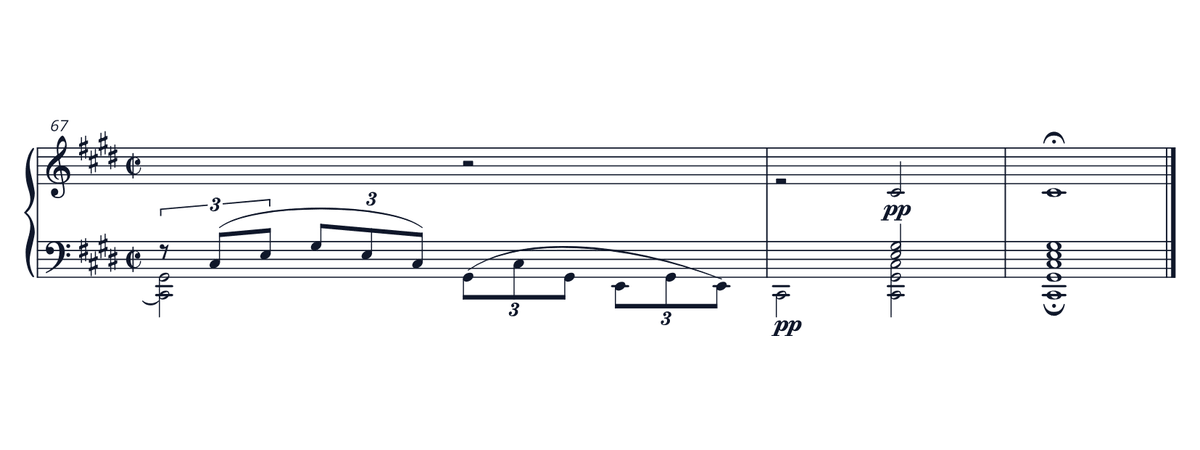
The first movement of Beethoven’s “Moonlight” Sonata, Op. 27 No. 2, dies away to a pp C♯-minor chord in bar 69 with a fermata above the right hand and an inverted fermata below the left. Because both hands sustain the same closing chord, they hold and release the keys together.
Just above the double bar stands Beethoven’s direction Attacca subito il seguente, meaning go straight into the next movement without a break. Whereas a fermata at the end of a movement normally invites a long pause before the next movement begins, attacca asks for the opposite: let the final chord resonate fully, then launch straight into the second movement before the spell breaks.
- Bars 67–69
How to practice a fermata
- Learn the passage in strict time firstLeave the fermata out at first and play through in steady time so the rhythm and voice-leading around it are solid. A held moment only sounds convincing when the pulse before and after it is clear.
- Count double length first, then switch to listeningTo get a feel for the proportion, start by holding the fermata note for twice its written beats. Once that feels natural, stop counting numbers and let the fading sound of the chord tell you when to move on.
- Drill the hold and the re-entry as one unitLoop the fermata note together with the two beats that follow it. While the chord rings, prepare your fingers for the next note, take a calm breath, and re-enter squarely in the original tempo.
- Respect silent fermatas and repeat barlinesOn a rest with a fermata, keep your hands quiet over the keys so the silence feels intentional. On a repeat barline with a fermata, keep moving on the first pass and hold only at the final conclusion.
Virtu waits for you at every fermata
Virtu’s Hear score and Demonstration playback shape fermatas naturally. When you play, Virtu pauses the clock for however long you choose to hold a fermata and resumes counting the beat from the very next note you strike.
- Reference playback holds notes shorter than two beats for twice their value plus one beat, and longer notes or rests for twice their value. Over a repeat barline, it takes a brief breath on the first pass and holds at the end of the piece.
- While you hold a fermata note, Virtu colors it green for the entire sustain. Even with the metronome turned on, the click pauses during the hold and picks back up in time with your re-entry note.
- Through rit. and accel. markings, Virtu tracks your pacing naturally, and when you reach a tempo, it locks back onto the main pulse.
Markings that are easy to mix up
Fermata vs. tenuto
A tenuto mark, the short horizontal line above or below a notehead, asks you to hold the note for its full written value with slight weight, without stopping the beat. A fermata stops the beat and holds the note beyond its written value.
Fermata vs. rit., rall., and ritenuto
Ritardando and rallentando, written rit. and rall., slow the pulse gradually across several beats or bars, while ritenuto drops immediately to a slower pace. All three remain in effect until a tempo appears. A fermata, by contrast, pauses time on a single note or rest, and the original tempo resumes right afterwards.
Upside-down fermatas
When placed underneath the bass staff or a lower voice, as at the end of the “Moonlight” first movement, the fermata arc is flipped upside down. Its musical meaning is identical.
Questions
Exactly how many beats should I hold a fermata?
There’s no fixed beat count. Holding for roughly twice the written duration is a reliable guideline, adjusted longer or shorter according to the tempo, acoustics, and musical mood. Virtu’s reference playback holds short notes for double their length plus a beat, and notes of two beats or longer and rests for double their length.
Should I leave a breath after a fermata before playing the next note?
Usually, yes. Leave a brief pause about the length of a singer’s breath before re-entering in the original tempo, or in the new tempo if one is marked. After a fermata over a rest or barline, let the moment of silence settle before continuing.
If I hold a fermata for a long time, will Virtu mark my timing late?
No. Virtu waits for you at every fermata and only restarts the beat clock when you play the note that follows. You can listen to the chord ring as long as the music calls for, then focus on keeping a steady pulse once you re-enter.