How to learn piano songs without reading music: listen first, then go bar by bar
You can learn a piano piece before you’re fluent at reading sheet music. Listen to the piece several times first so the melody and rhythm settle in your ear, then find the notes on the keyboard one measure at a time: right hand, left hand, then both hands together. Set the beat aside while you locate the keys; once your fingers know where to go, bring the pulse back in.
At a glance
- Listen to the entire piece a few times before touching the keys.
- Learn one measure at a time, right hand, left hand, then hands together, carrying over to the first note of the next measure.
- Correct any wrong note on the spot; once you play the measure twice cleanly, move on.
- Once all the notes are under your fingers, start playing in time at a slow tempo, one hand at a time.
When this approach works best
Use this approach when reading note names takes long enough that the beat slips away before you find the next key. It splits two demanding tasks apart: your ear learns how the music flows first, while your hands only have to find one measure of keys at a time.
- You have a specific piece you want to play, but your note-reading is still slow.
- You can hum the melody by heart, yet you’re not sure where it sits on the keyboard.
- Trying to read the score and keep a steady beat at the same time makes you stall in every measure.
If you’d like to build note-reading skills from the ground up, see how to start learning piano and how to improve piano sight-reading. For bringing each hand into steady time once you know the notes, see hands-separate practice.
Why listening comes before playing
While you’re hunting for individual keys, you have very little attention left for rhythm, phrasing, or line. When you already know how the piece sounds, your ear expects the rise, fall, and rhythm of the next note even while your hands move slowly, making it much easier to connect isolated notes into real music.
Hearing a model performance before you start practicing gives you a clear sense of tempo, character, and touch, so you aren’t just pressing keys in sequence, but matching a sound you already recognize.
- mm. 1–8 · Written tempo
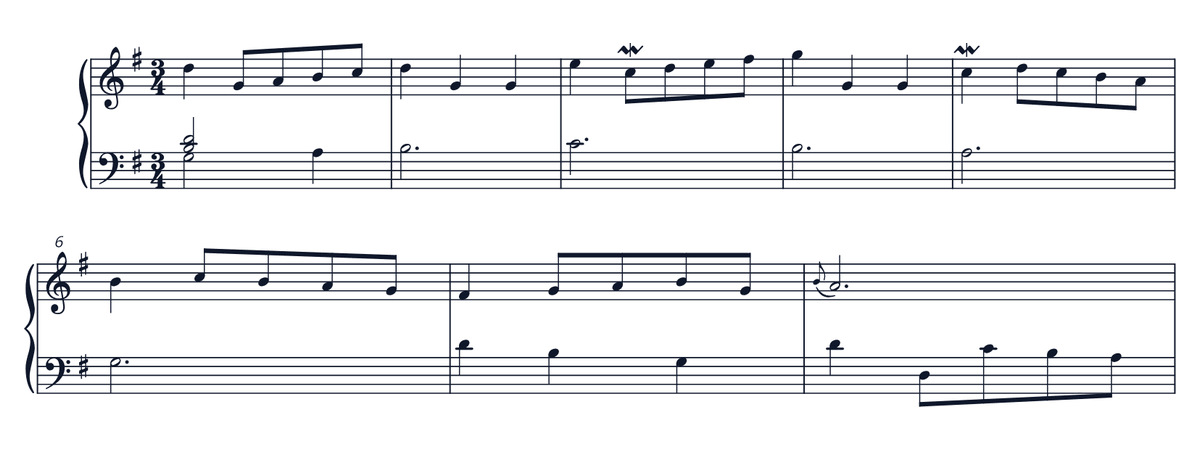
Listen first, then learn measure by measure
- Listen to the whole piece a few timesPlay the recording from start to finish and let your ear absorb the main melody and recurring phrases. You don’t need every detail memorized, just enough familiarity to sense what comes next. In Virtu, tap Listen in Explore to hear any piece before downloading it.
- Hear one measure, then find it on the keysListen once more to the single measure you’re about to learn, then locate those pitches on the keyboard while the sound is fresh in your ear. On the score screen, double-tap any measure to play from that bar immediately.
- Right hand, left hand, then both handsLearn the measure with the right hand alone, then the left hand alone, and finally put both hands together. Once both hands feel comfortable in that measure, move to the next.
- Carry over to the first note of the next measureDon’t stop dead at the barline. Include the first note of the following measure so your hands practice the shift across the barline at the same time.
- Fix wrong notes on the spotIf you press a wrong key, don’t brush past it: pause, find the right key and finger, and play through cleanly. Once you play the measure twice from start to finish without a slip, move on.
- Bring the pulse back in once the notes are familiarWhen you no longer have to hunt for the keys, play each hand in steady time at a comfortable slow tempo, then combine hands. Use the rhythm you absorbed from the demonstration as your guide.
In Virtu, start with Learn from the start
Tap Add deck on a piece and choose Learn from the start at the top. Today’s queue will present the piece one measure at a time: right hand, left hand, then both hands. Each time a measure opens, Virtu plays a demonstration at the written tempo first and lights up the target keys in blue on the 88-key keyboard at the bottom of the screen.
- The score waits until you press the right key. You can find notes one by one without a metronome ticking; right notes turn green on the staff, and any wrong key appears in red at the pitch you struck.
- During single-hand steps, the demonstration softly plays the other hand underneath so you hear the full harmony. Tap Demo anytime to hear it again.
- Play the measure to the end twice without a wrong key to complete it, then tap Next. The screen tracks your progress, such as Clean 1/2, and you can adjust the required count under Clean plays to finish in the settings menu.
- As soon as you finish learning all the measures, Left hand and Right hand steps unlock the same day with rhythm evaluation turned on. After any run, tap Hear both to hear the score and your own playing layered together.
Common mistakes to avoid
Pressing keys before listening
If you hunt for keys you’ve never heard, you can press all the right pitches and still have no sense of how they connect into a phrase. Listen to the whole piece before you start, and listen to each measure right before you learn it.
Brushing past wrong notes
If you keep going after a wrong note, your fingers are just as likely to repeat that mistake on the next pass. Whenever a note slips, stop immediately, check the exact key and finger, and repeat the measure until you get two clean runs in a row.
Learning only the right-hand melody
Because the melody is catchy, the right hand comes quickly, but a piano piece needs the left-hand bass and harmony to sound complete. Finish the left hand and hands-together steps for each measure before moving forward.
Staring only at the keyboard
Even while the on-screen keyboard guides your fingers, keep the staff in view and notice which notehead turns green when you press a key. Seeing the same noteheads light up again and again builds your sight-reading naturally as you learn pieces.
Questions
Do I need to know how to read sheet music at all?
No. You can locate the pitches using the on-screen 88-key guide and follow the musical flow by ear. Learn from the start in Virtu highlights the exact keys to press and turns each note green on the score as you play it, showing you how the staff and the keyboard map to each other.
How many times should I repeat each measure?
Playing a measure twice from start to finish without a wrong note is a reliable benchmark before moving on; give a tricky measure an extra pass or two if needed. In Virtu, you can set Clean plays to finish anywhere from 1 to 5 in the settings menu.
Can I listen to the piece at a slower tempo?
Yes. On the score screen, open Metronome settings, switch Tempo to Set my own, and lower the BPM. Playback will follow your chosen speed. Once you move on to the timed Left hand and Right hand steps, the demonstration automatically plays at that step’s practice tempo.