How to play piano trills and ornaments: mordents, turns, grace notes, and rolled chords
A trill, marked tr, rapidly alternates the written main note and the note right above it. Baroque and Classical repertoire usually starts a trill on the upper note, while Romantic and later repertoire usually starts on the main note. There’s no fixed number of alternations, so play only as fast as every note stays clear. A mordent moves main–lower–main, a turn traces upper–main–lower–main, a grace note is a small note before a main note, and a vertical wavy line before a chord means roll it from the bottom up. Whatever the ornament, lock in the basic rhythm without it first, then fit the ornament inside the beat.
At a glance
- A trill alternates the main note and the upper note. The starting note follows the style of the period.
- A mordent with a vertical stroke flicks the lower note; an upper mordent without a stroke flicks the upper note, both on the beat.
- An unslashed grace note lands on the beat and takes time from the main note; a slashed grace note is a quick, light brush.
- Virtu accepts both main-note and upper-note trill starts, as well as upward or downward chord rolls.
- Bars 1–4
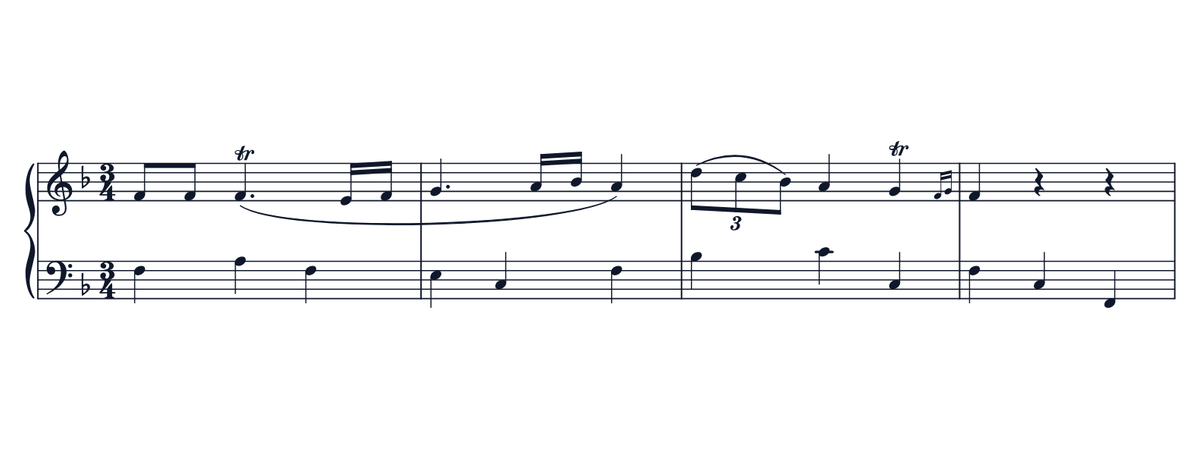
Trills, mordents, and turns: where they start and how fast they go
Trill
Rapidly alternate the written main note and the scale note a step above it. The upper note follows the key signature unless a small accidental above the tr alters it. When a wavy line follows, keep alternating to the end of the line.
- Starting note: In Baroque and Classical music by Bach, Haydn, Mozart, and early Beethoven, trills normally begin on the upper note on the beat, bringing out the harmonic tension before resolving to the main note. From the Romantic era onward, including Chopin, Liszt, and Brahms, trills normally begin on the main note to keep the melody line clear. Even in eighteenth-century music, a main-note start is common at the very opening of a phrase, right after a rest, after a downward leap, or when the preceding note is already the upper note. If a small grace note precedes the tr, start on that pitch.
- Speed and number of notes: There’s no fixed count. Play at a speed where every alternation speaks clearly without stiffening your hand. If trills on your fourth and fifth fingers feel uneven, work on finger independence; if your forearm tightens up, check releasing hand tension first.
- Ending notes: Most longer trills finish with a two-note turn dipping to the lower note and returning to the main note before moving to the next beat, often written out directly as in the Mozart example above.
Mordent and upper mordent
A short wavy line crossed by a vertical stroke is a mordent, playing main–lower–main. Without the vertical stroke, it’s an upper mordent or pralltriller, playing main–upper–main. Both snap quickly on the beat within the main note’s time value, leaving the weight and remaining duration on the final main note.
Turn
A sideways S-shaped sign. Placed directly over a notehead, it plays four notes, upper–main–lower–main, right on the beat. Placed between two notes, to the right of the main note, you sound the main note on the beat first, then curl through the four-note turn just before the next beat arrives. A small accidental above the turn sign changes the upper note; one below changes the lower note.
Grace notes and rolled chords: before the beat or on the beat
Grace notes
A small note printed just before a main note. Without a diagonal slash through the stem, it’s a long grace note, or appoggiatura: play it squarely on the beat together with the left hand, let it take half the main note’s value or two-thirds of a dotted note, lean into it warmly, and resolve softly to the main note. With a slash through the stem, it’s a short grace note, or acciaccatura: flick it lightly and keep the rhythmic weight on the main note. Depending on style and phrasing, pianists place short grace notes either slightly ahead of the beat or right on the beat with the bass note.
Rolled chords
A vertical wavy line in front of a chord tells you to roll the notes rapidly from the lowest pitch to the highest instead of striking them all at once. If a downward arrow is attached, roll from top to bottom. Hold each note down with the fingers or pedal for the chord’s written duration. In lyrical passages, placing the top melody note on the beat keeps the melody pulse clear, whereas starting the bottom note on the beat gives a more relaxed, harp-like spread.
Petzold’s Minuet: mordents and a long grace note
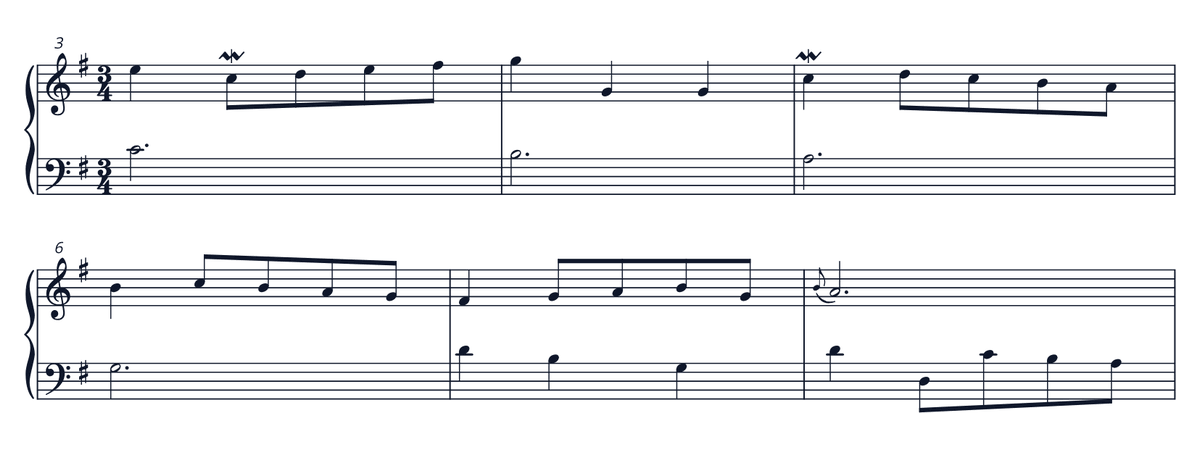
The C on beat 2 of bar 3 and beat 1 of bar 5 carries a stroked mordent. Play C–B–C crisply on the beat and rest on the final C for the remainder of the quarter note. Because a minuet is a poised court dance, don’t let the ornament delay the pulse. Keep the following eighth notes strictly in time.
The small B in bar 8 is an unslashed long grace note. Play B on the downbeat with the left hand, lean into the dissonance, and release gently down to A along the slur.
- Bars 3–8
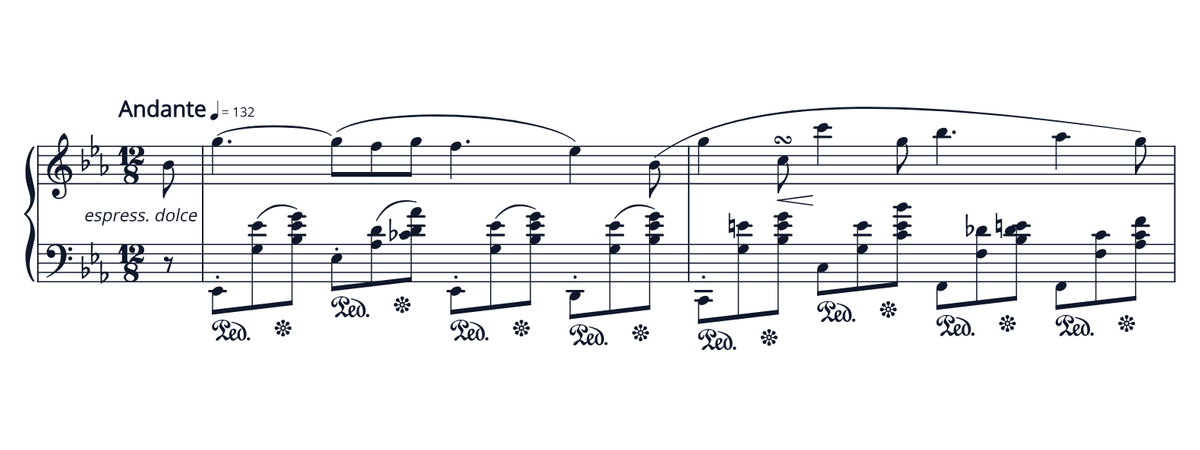
Chopin’s Nocturne Op. 9 No. 2: turns, upper mordents, and trill endings
A singing melody richly decorated with expressive vocal-style ornaments.
- Bar 2: A turn sits over the eighth-note C. Spin lightly through D–C–B–C from the upper note and float up to the high C.
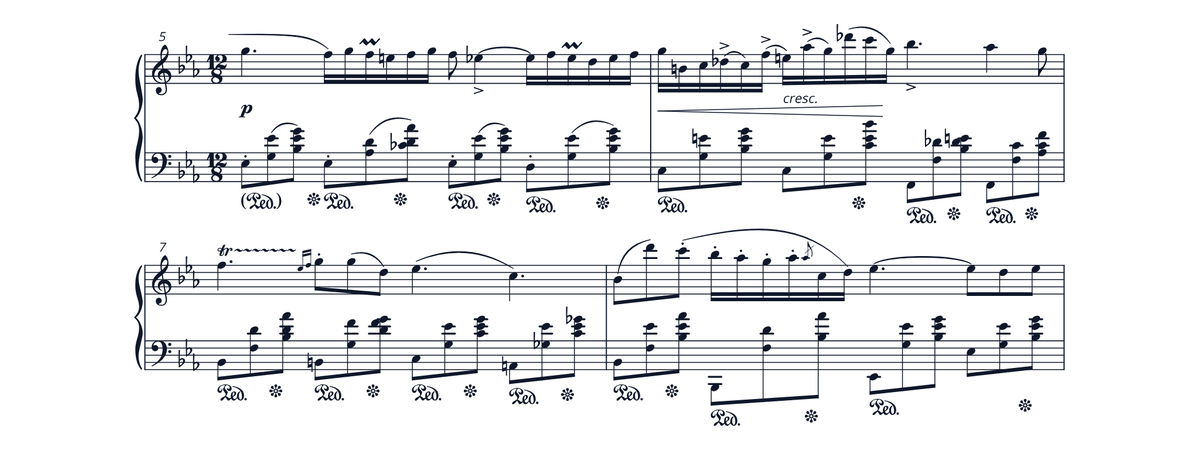
- Bar 5: The unstroked wavy signs over F and E♭ are upper mordents, moving main–upper–main. Because they sit inside sixteenth-note motion, keep them delicate and effortless.
- Bar 7: Hold the trill on F to the end of the wavy line, then round it off with the small ending notes E♭–F leading smoothly into G.
- Bar 8: The slashed grace note is a quick ornament brushed lightly into the main note.
- Bars 0–2
- Bars 5–8
Debussy’s Clair de lune: rolled chords
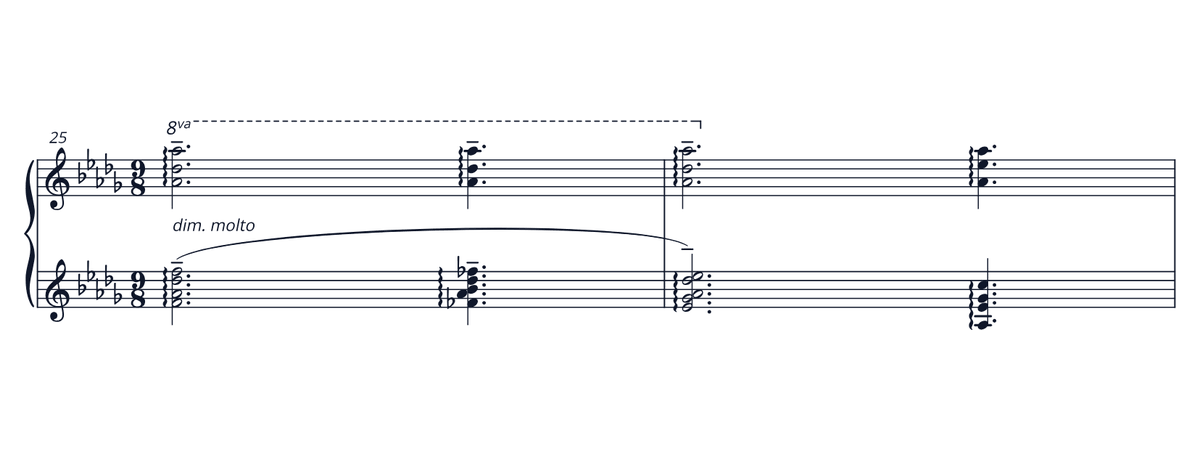
In bars 25–26 every chord carries a vertical wavy line, engraved separately for each hand as the sound dies away dim. molto.
- Decide before you play how the roll lines up with the beat. Putting the top note on the beat keeps the upper melody line in strict time; starting the bottom note on the beat lets the chord bloom unhurriedly across the pulse.
- Roll smoothly from the bottom note upward with a gentle turn of the wrist and forearm, holding the keys down for the chord’s full value.
- Bars 25–26
How to practice ornaments step by step
- Play the basic rhythm firstPractice the passage with all ornaments left out so your hands lock in the underlying pulse, voicing, and fingering. An ornament must fit inside that rhythmic frame without pulling it out of shape.
- Write out the exact notes and practice slowlyFor a trill, choose your starting pitch, the exact number of alternations at a slow tempo, and the ending notes, then pencil them above the staff. Practice those exact subdivisions slowly before letting the trill flow freely at speed.
- Aim for the next downbeatArriving on the note after the ornament cleanly and on time matters far more than cramming in extra notes. Loop from the ornament into the following beat as a single motion.
- Stay close to the keys with a loose wristKeep your fingertips in contact with the key surfaces and let a gentle turn of the wrist and forearm help the fingers alternate. For rolled chords, turn the wrist smoothly in one continuous arc.
In Virtu, multiple performance traditions count as right
Virtu’s “Hear score” and Demonstration play ornaments in style: trills run at roughly eleven notes per second, starting from the upper note where indicated and from the main note otherwise, and rolled chords sweep upward from the bass to land on the beat. When you play, Virtu accepts the full range of musically valid interpretations.
- A trill counts as right whether you begin on the main note or the upper note, and regardless of how many alternations you play. Keep it going through the end of the note’s duration for green; stop early and it shows yellow. Mordents turn green once you include the neighboring note, and turns once you include both the upper and lower notes.
- Grace notes count as on time whether placed just before the beat or on the beat. Rolled chords count as on time whether rolled upward or downward, quickly or leisurely; if you play a traditionally rolled chord as a flat block, Virtu lets you know: “The chord was struck together instead of rolled.”
- Omit an ornament altogether and Virtu flags “The note was played without its ornament” and logs a missed note. It also highlights stray keys that slip into the middle of an ornament.
Ornament signs that are easy to mix up
Mordent vs. upper mordent
A vertical stroke through the middle of the wavy sign points down to the lower note, moving main–lower–main. Without the vertical stroke, you flick up to the upper note, moving main–upper–main. Think of the vertical stroke as a downward pointer.
Small notes at the end of a trill
Two small notes printed right at the tail of a trill are its ending notes, not grace notes belonging to the next measure. Fit them smoothly into the end of the trill’s duration so the following main note lands squarely on the beat.
A turn directly over a note vs. after a note
When the turn sign sits directly above the notehead, begin on the upper note right on the beat. When it sits to the right of the notehead, hold the main note first and curl through the four-note turn just before moving to the next pitch.
Slashed vs. unslashed grace notes
An unslashed small note lands on the beat and takes a substantial share of the main note’s duration; a slashed small note is a rapid flick that leaves the rhythmic weight on the main note.
Questions
How many notes should a trill have?
There’s no fixed number. Play only as fast as you can keep the tone even and clear, and keep alternating through the full written value of the note. Virtu checks whether you kept the trill alive to the end rather than counting a specific number of notes.
Does a trill start on the upper note or the main note?
As a general guide, Baroque and Classical pieces start on the upper note, while Romantic and later pieces start on the main note. Phrasing and melodic context can create exceptions, and a small grace note before the trill always tells you which pitch to start on. Virtu accepts both.
Do I have to roll a chord marked with a wavy line?
Yes. If you strike all the notes at once as a block chord, the pitches still register, but for chords that standard performance practice rolls, Virtu marks the chord in yellow with “The chord was struck together instead of rolled.”