Changing dynamics: shape a passage with crescendo and diminuendo to even out your touch
Changing dynamics plays a passage once gradually growing louder and once gradually growing softer before returning to the written score. Because grading the volume note by note asks you to measure out arm weight to every finger, passages where strong fingers bark and weak fingers disappear quickly become more even.
At a glance
- Use it when notes in a fast run jump out or drop out, or when your playing ignores the written dynamics.
- Play the passage once with a crescendo and once with a diminuendo, then return to the original score.
- No exact decibel target is needed. The end of the passage simply has to sound clearly louder or softer than the start.
When to use it
Use this drill when thumbs and index fingers bang out while fourth and fifth fingers vanish inside a run, or when a passage marked p comes out loud and flat. Deliberately shading the volume across every note trains smooth weight transfer from finger to finger.
- Runs of four or more equal notes and active chordal accompaniments.
- Passages where your played dynamics don’t match the score markings.
- Whenever one hand has noticeably bumpier tone control, practice that hand on its own.
How the score changes
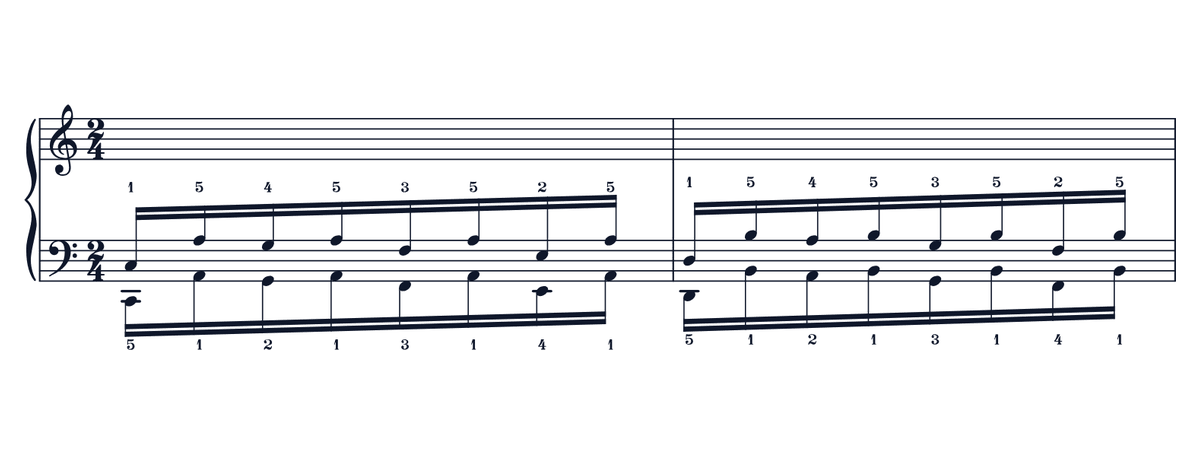
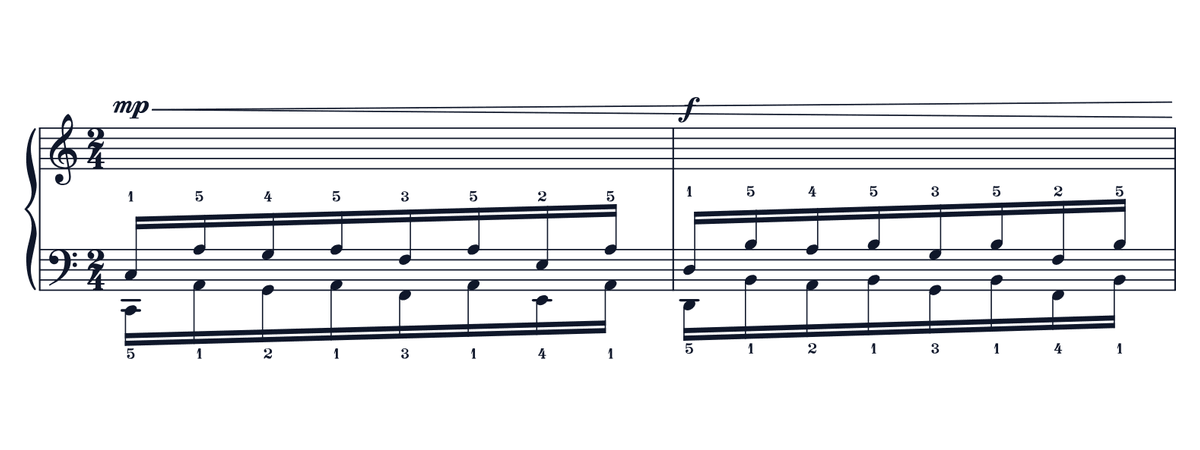
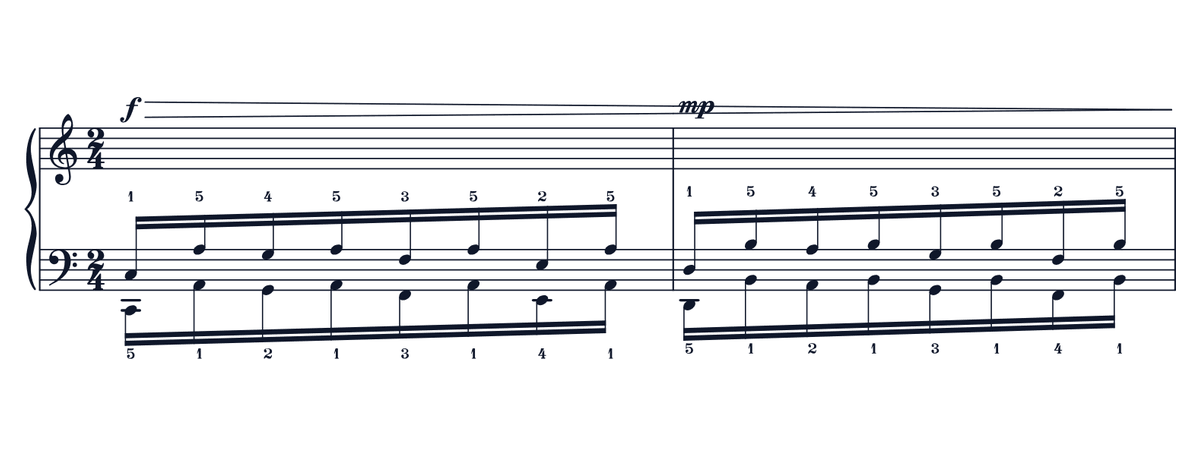
Add a hairpin over the passage in the hand you’re working on: a crescendo on the first pass, and a diminuendo on the second. Frame the hairpin one dynamic level below and one level above the written marking. For example, an mf passage goes from mp to f, then from f to mp. Pitches, rhythm, and fingering stay the same.
- As written
- Growing louder
- Growing softer
Practice steps
- Once as writtenPlay the passage normally and listen for which fingers poke out or get swallowed.
- Growing louderBegin softly and add a fraction more arm weight with every note to the end of the passage, avoiding any sudden jump on a single note.
- Growing softerBegin firmly and taper the weight smoothly to the end, keeping the quietest final notes from dropping out completely.
- Back to the scorePlay the passage with its written dynamics and compare: is the tone more balanced from finger to finger?
In Virtu, hairpins appear right on the score
From the Technique stage onward, Virtu highlights bars where one hand’s passagework was uneven in tone or missed the written dynamics. Choose Practice with changing dynamics in the results, and Virtu rewrites those bars with a crescendo hairpin and plays a demonstration. When dynamics didn’t match the score, the primary recommendation usually starts with this drill.
- Virtu checks that the final third of the passage was louder than the opening third on the first pass, and softer on the second. Because it compares relative direction rather than raw volume, differences in keyboard touch sensitivity won’t skew the result.
- If the dynamic shape wasn’t clear, Virtu points out the bar and lets you try the pass again.
- After both passes, you return to the original score and see how your tone evenness compares with your first run and with plain repetition.
Changing dynamics and all seven guided practice drills are included with Virtu Plus.
Changing dynamics 1/2 doneNext: growing softer · 2/2
Common mistakes
Jumping in volume on a single note
Sudden accents in the middle of the bar, often when the thumb passes under, break the gradual change. Spread the increase or decrease evenly across every note.
Rushing the crescendo or dragging the diminuendo
It’s a common habit to speed up as you play louder and slow down as you play softer. Keep the pulse steady and change only key speed and arm weight.
Practicing only the crescendo
Always growing louder trains you only to add weight. Pairing it with the diminuendo teaches you how to lighten your touch without losing finger support.
Stop if your wrist or forearm feels tight. Never press or squeeze into the keybed to play louder. Let supple arm weight drop through firm fingertips, and release right after each key speaks.
Other drills for the same passage
- Changing dynamicsGrow louder, then softer, to even out each finger's weight
- Dotted rhythmsPlay it long–short and short–long to even out the notes
- Shifting accentsMove a strong note along so every finger rings clearly
- Short burstsPlay a few notes fast, then stop, beat by beat
- Alternating temposAlternate slow with the speed you're practicing at
- Playing staccatoPlay every note short to keep your fingers light
- Play as chordsPress each broken chord at once to learn the hand shape first
Questions
How wide should the crescendo and diminuendo be?
Wide enough that the end of the passage sounds clearly louder or softer than the beginning. Virtu checks relative direction rather than demanding extreme volume.
Can I use this drill when the score has no dynamic markings?
Yes. When no dynamic is marked, Virtu treats the baseline as mf and guides you from mp to f and back. Because the goal is finger-to-finger tone control, it works on any passage.
If my goal is an even tone, why practice changing the volume?
Grading a smooth crescendo or diminuendo forces you to hold back naturally heavy fingers and support naturally weak ones on every note. Once you have that control, holding a steady dynamic level becomes much easier.