Short bursts: stop on the beat to bring fast passagework up to tempo
Short-burst practice breaks a fast passage at the beat: play one beat’s notes in a single crisp impulse, land and pause on the first note of the next beat to relax your hand, then continue. Practice stopping every beat, widen the group to every two beats, and then return to the score as written. The speed and clarity you can manage in a four-note group carries over into the full passage.
At a glance
- Use it when a passage is clean at a slow tempo but unravels halfway through as you speed it up.
- Play once pausing on the first note of every beat, then once pausing every two beats, before playing straight through.
- The fermata pause has no fixed duration, so wait until your hand is completely relaxed and the next group is mapped out.
When to use it
Use it when a scale, arpeggio, or passage that feels comfortable slowly starts to rush, stumble, or tense up as you bring it toward performance tempo. Even when your hand isn’t ready to sustain two full bars of sixteenth notes at speed, it can almost always play a single four-note beat cleanly. Firing one beat of notes right onto the next beat’s first note as a single physical gesture, then pausing to release tension, teaches your hand how fast playing feels without building up fatigue.
- Passagework with two or more equal notes per beat: sixteenth-note scales, broken chords, chromatic runs, and studies such as Hanon or Czerny.
- When your fingers consistently fall behind or blur at the same beat as you raise the metronome.
- When one hand loses control before the other: isolate that hand first.
How the score changes
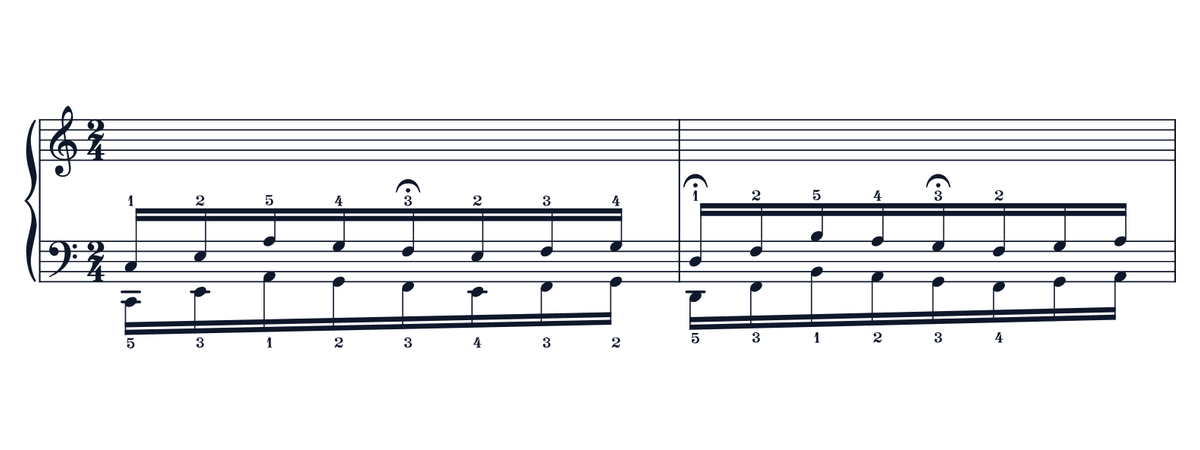
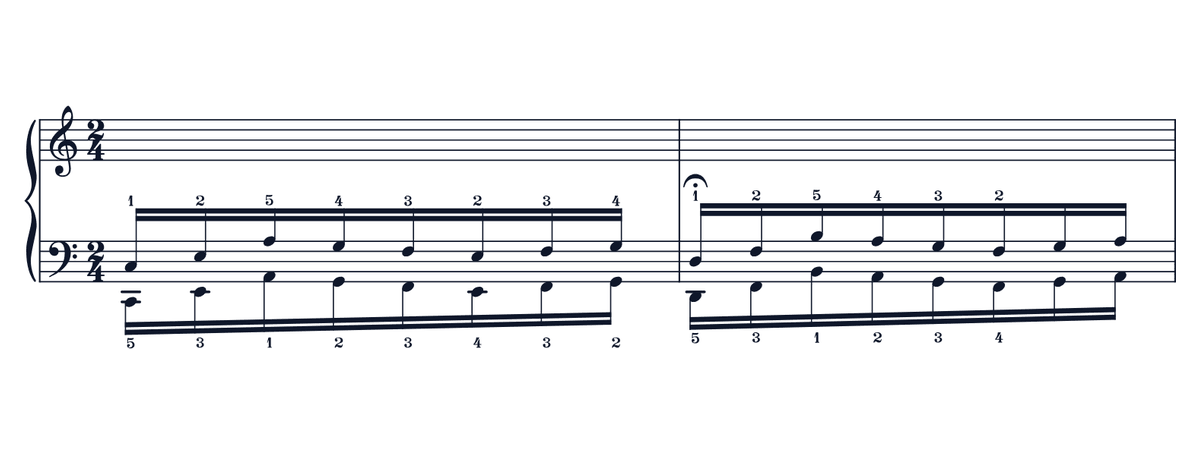
Skip the very first note of the passage and place a fermata on the first note of every beat after that. Sweep through one beat’s notes in a single motion and stop right on the fermata note, which is the downbeat of the next group. Relax your hand while holding that note, picture the next group, and launch again from that same note. On the first pass, stop every beat; on the second pass, join two beats together and stop every two beats. Because the pauses are unmeasured, keep the metronome off during the bursts.
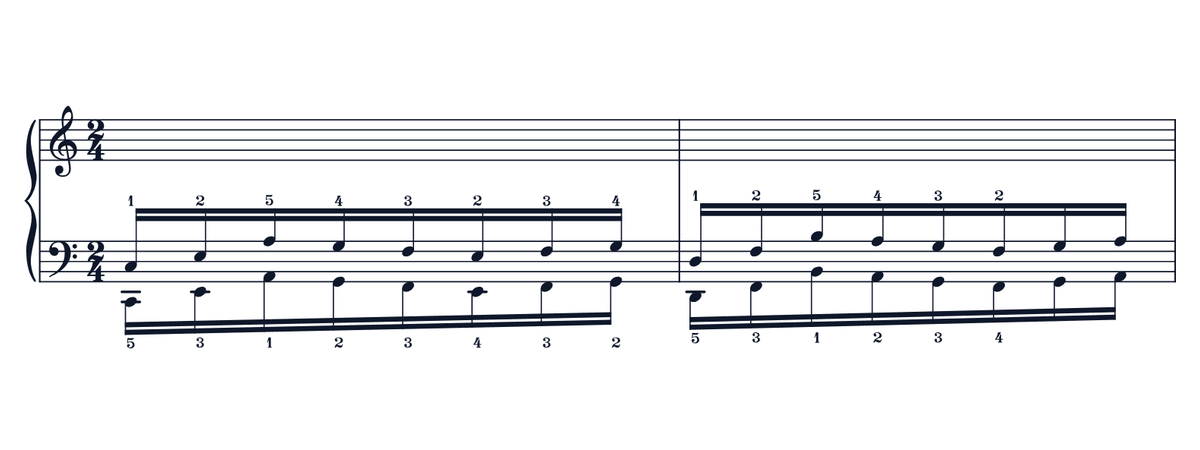
- As written
- Stop every beat
- Stop every two beats
Practice order
- Once as writtenListen for which beat starts to blur or rush. Choose the tempo right where the full passage begins to break down.
- Pause on every beatPlay one beat in a single quick gesture and land cleanly on the first note of the next beat. While resting on the fermata, release all wrist and finger tension and prepare the next beat’s hand position.
- Pause every two beatsNow link two beats in one sweep before stopping on the third beat’s downbeat. This bridges short impulses into longer phrases.
- Return to the written scorePlay straight through without pauses at the same tempo and notice how each beat’s downbeat acts as a calm landmark.
In Virtu, the stops go on the score
From the Technique stage on, after you play, Virtu points out the bars where one hand’s run came out uneven. Choose Practice in short bursts in the result, and it rewrites those bars with a fermata on each beat and plays them to you once. Practice waits at each fermata, and the metronome is off.
- It checks that each burst between the stops came out even. How long you paused on the fermata doesn’t matter.
- The speed within each burst stays at your practice tempo.
- When the set finishes, you return to the score and see whether the run came out more even compared with plain repetition.
Short bursts and the other six practice drills come with Virtu Plus.
Short bursts 1/2 doneNext: two beats at a time · 2/2
Common mistakes
Pressing hard into the key during the pause
The fermata is for releasing tension and mentally preparing the next group, not for clamping down on the key bed. Let your wrist float free as soon as you land.
Stopping at the end of a beat instead of on the next beat’s first note
If you play four sixteenths and stop on the fourth, you never practice the crucial transition across the beat line. Always play through to the first note of the next beat so the hand shift is part of the burst.
Never joining the one-beat bursts into longer groups
Practicing only one-beat stops can leave a habit of hesitating on every beat. Always progress to two-beat bursts and finish by playing the passage straight through.
Other drills for the same passage
- Short burstsPlay a few notes fast, then stop, beat by beat
- Dotted rhythmsPlay it long–short and short–long to even out the notes
- Shifting accentsMove a strong note along so every finger rings clearly
- Alternating temposAlternate slow with the speed you're practicing at
- Playing staccatoPlay every note short to keep your fingers light
- Changing dynamicsGrow louder, then softer, to even out each finger's weight
- Play as chordsPress each broken chord at once to learn the hand shape first
Questions
How long should I hold each fermata pause?
Hold it for as long as it takes to let go of any forearm tension and picture the entire next burst in your mind. Early on that might be two or three seconds; as the passage settles, the pauses naturally shrink.
How fast should I play the notes inside each burst?
At the target tempo where playing the whole passage nonstop starts to fall apart. If the notes inside a single one-beat burst still sound smeared, lower the tempo slightly until each burst is crystal clear.
Should I use a metronome during short-burst practice?
Leave the metronome off during the bursts because the fermata pauses are unmeasured. Turn the metronome back on when you return to the written score to verify that the full run stays on the beat.