Alternating tempos: carry slow-practice clarity over to target speed
Alternating tempos keeps the score unchanged and plays the passage once at a comfortable slow tempo, then once at your working practice tempo, twice through, before finishing at your practice tempo. Because you refine each finger’s placement slowly and immediately test it at speed, the control you find in slow practice carries right into the tempo you actually play.
At a glance
- Use it when a passage is clean in slow practice but turns uneven, or rushes and drags, at speed.
- Play it slow, at practice tempo, slow, at practice tempo, then finish with one final take at practice tempo.
- Set the slow tempo to about 70% of your working tempo. Alternate strictly between those two tempos rather than wandering through many.
When to use it
Use this drill when a passage feels tidy at a slow pace but blurs together as you speed up, or when easy bars rush ahead while tricky bars drag behind. Clean slow playing doesn’t automatically turn into clean fast playing. Your hand has to coordinate the same movements at the actual speed of performance.
- Passages you’ve only practiced slowly that fall apart when brought up to tempo.
- Measures that rush or drag internally.
- Chordal leaps and accompaniments as well as rapid scale or arpeggio runs.
Only the tempo changes
Nothing in the notation changes, only the tempo. The slow tempo sits at about 70% of your working speed. That’s slow enough to hear every note clearly and prepare each finger, yet fast enough to feel the phrase as one gesture. Don’t push the fast take beyond your limit. Keep it right at your current practice tempo, and simply alternate between those two speeds in turn.
- At practice tempo
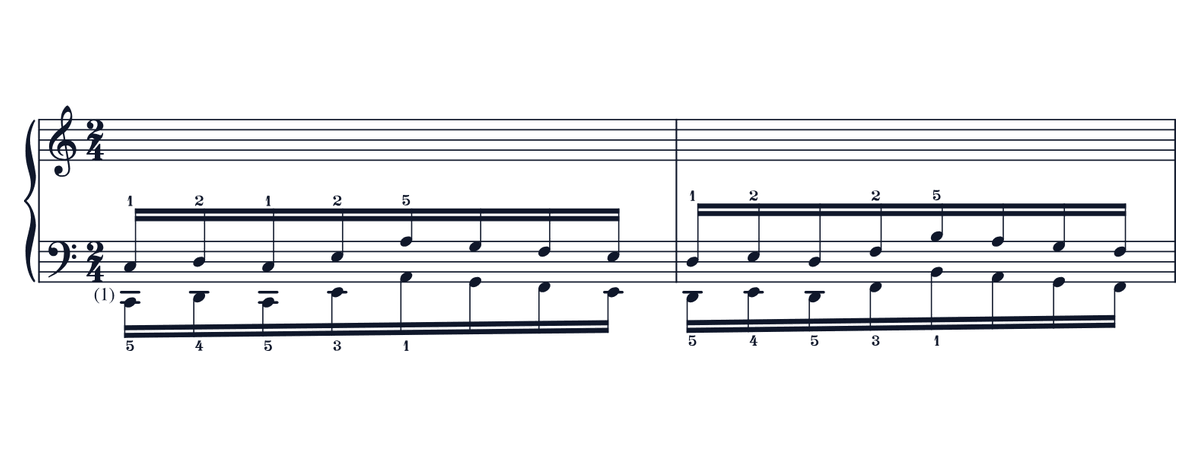
- Slow tempo
Practice steps
- Slow, onceListen to every note and place it squarely on the beat. Notice how each finger prepares its next key without tension.
- At practice tempo, onceTest whether the same ease and evenness hold at speed. If a beat bunches up or hesitates, note the exact spot for your next slow take.
- Alternate once morePlay one more slow take, followed by one more take at practice tempo, making four takes in total so far.
- Finish at practice tempoAlways close on your working tempo, since that’s the speed where the passage has to hold together. Compare the evenness with your very first play-through.
In Virtu, the tempo switches for you
From the Technique stage onward, Virtu highlights bars where one hand’s passagework came out uneven or where the tempo rushed or dragged. Choose Practice alternating tempos in the results, and Virtu plays those bars once at the slower pace, then switches the target tempo automatically for each take. When a passage rushes or drags, the primary recommendation usually starts with this drill.
- Each take verifies that all notes in the active hand were played accurately. If a note is missed, you repeat the take at the same tempo.
- After every take, Virtu cues whether the next pass is slow or at speed.
- When you finish at your practice tempo, Virtu compares your timing evenness against your initial run and side by side with plain repetition.
Alternating tempos and all seven guided practice drills are included with Virtu Plus.
Alternating tempos 1/4 doneNext: fast · 2/4
Common mistakes
Pushing the fast take faster and faster
The fast take isn’t a speed test. Keep it anchored at your working practice tempo so you can genuinely tell whether the clarity from the slow take has carried over.
Zoning out on the slow take
The slow pass is where you listen closely, release excess hand tension, and refine finger preparation. Rushing or skimming through it defeats the purpose of alternating.
Changing to random tempos every time
Jumping among four or five different speeds makes it harder to lock in a steady internal pulse. Alternating between two clearly defined tempos gives your hands a consistent reference frame.
Other drills for the same passage
- Alternating temposAlternate slow with the speed you're practicing at
- Dotted rhythmsPlay it long–short and short–long to even out the notes
- Shifting accentsMove a strong note along so every finger rings clearly
- Short burstsPlay a few notes fast, then stop, beat by beat
- Playing staccatoPlay every note short to keep your fingers light
- Changing dynamicsGrow louder, then softer, to even out each finger's weight
- Play as chordsPress each broken chord at once to learn the hand shape first
Questions
How slow should the slow tempo be?
About 70% of your working practice tempo. That gives you enough breathing room to hear every note and prepare each finger without breaking the phrase into disconnected notes.
Why not just practice slowly the whole time?
Playing slowly and playing up to speed use slightly different movements and arm-weight balance. Alternating lets you keep the accuracy of slow practice while training the motion you need at tempo.
Should I use a metronome?
Yes, especially if you tend to rush easy beats or drag hard ones. Switching between two fixed metronome markings keeps both tempos honest.